The question every bride asks is not really about colour or embroidery or designer names. It is about self-recognition — about standing in front of a mirror and seeing, perhaps for the first time, exactly the woman she intended to become on this one particular day. The right bridal lehenga does not transform a bride. It completes her.
The difference between a lehenga that does this and one that merely looks beautiful on a hanger lies almost entirely in how well the silhouette, fabric, and construction account for her actual body. Not a sample body. Not the body in the reference photograph. Her body — with its specific proportions, its strengths, the way it holds a drape in motion rather than in stillness.
This guide — written from the design philosophy of Aahana's by Nidhi Mehra, a luxury bridal atelier in Noida — is the framework Nidhi Mehra uses in every consultation. It is not a set of rules to follow. It is a language to acquire, so that you can walk into any fitting with clarity about what you want and why.
- The silhouette should balance your proportions — not hide your body type, but complement it
- The fabric weight should suit your climate, your wedding timeline, and your silhouette goal
- Embroidery placement directs the eye — concentrate it where you want attention
- The blouse is where fit is won or lost — a perfect blouse rescues an average skirt; the reverse is rarely true
- Order at minimum 4–6 months in advance for a fully custom piece
Why Body Type Matters for a Bridal Lehenga
A bridal lehenga is not a static object. It exists in motion — worn across six, eight, sometimes twelve hours of rituals, photographs, and dancing. The way it sits at rest in a showroom is approximately half the information you need. The other half is how it moves, how it redistributes its weight as the bride walks, how the skirt falls when she turns to face someone she has not yet seen that day. These are the qualities that body-type-informed design controls.
Proportion is the principle underneath it all. When your silhouette is in proportion — when the visual balance between your shoulders and hips, your torso and your legs, your embellishment and your bare fabric, is at rest — you stop thinking about what you're wearing. The lehenga becomes invisible in the best possible sense. What remains is you.
This is not a conversation about concealment. It is a conversation about architecture. At Aahana's by Nidhi Mehra, body type is the first element of any bridal brief — not as a limitation, but as a starting point. Everything else — silhouette, fabric, embroidery density, dupatta drape — follows from it with logic.
This guide uses body type categories as practical design tools, not as judgements. Every body type named here has been worn beautifully by real brides who left their final fitting feeling exactly as they should. The goal is never to minimise or apologise for your proportions. It is to dress them with intelligence and luxury.
The 8 Female Body Types — Explained
Before applying specific recommendations, identify your body type using the simple framework below. Stand naturally, measure (or estimate) your bust, waist, and hip measurements, and observe where your body carries its width.
| Body Type | Characteristics | Key Design Goal |
|---|---|---|
| Pear | Hips wider than shoulders; narrower upper body | Balance: add visual width to shoulders |
| Apple | Fuller bust and midsection; narrower hips | Elongate torso; define waist |
| Rectangle | Shoulders and hips similar width; minimal waist definition | Create curves; define waist |
| Hourglass | Defined waist; balanced bust and hips | Celebrate proportions; maximise drama |
| Petite | Under 5'3" in height | Create height; elongate silhouette |
| Tall | 5'7" and above | Embrace volume; balance height with fabric weight |
| Plus Size | Fuller figure; larger proportions across all areas | Create flow; emphasise best features; prioritise comfort |
| Athletic | Broader shoulders; narrower hips; defined musculature | Add volume to lower half; soften shoulder line |
Pear Body Type — Bridal Lehenga Guide
Suggested Image
A bride with a pear silhouette in a structured puffed-sleeve blouse and gently flared A-line lehenga — embroidery concentrated on the blouse and upper skirt
ALT Text: Bridal lehenga styling guide for pear body type — A-line silhouette with structured blouse by Nidhi Mehra Noida
The pear body type — characterised by hips and thighs that are wider than the shoulders — is among the most common in Indian bridal clientele. The design goal is simple to state: visual width needs to move upward. The challenge lies in achieving this without drawing attention to the very disproportion you are trying to balance. The wrong approach adds embellishment to the upper body in ways that feel forced; the right approach builds structure into the blouse that makes the balance feel natural and inevitable.
Pear Body Type
Wider hips · Narrower shoulders
Silhouette
A-line or gentle flare. The skirt should widen gradually from a high, defined waistband — not sharply from the hip.
Fabric
Heavier, structured fabric for the blouse (raw silk, velvet); lighter, flowing fabric for the skirt (layered organza, net) to skim hips without clinging.
Embroidery Placement
Concentrate embroidery on the blouse front, sleeves, and the upper third of the skirt. Minimal embroidery on the hip panels.
Neckline
Wide and horizontal — boat neck, square neck, or wide V — to visually widen the shoulder line.
Blouse
Structured with shoulder detail: puffed sleeves, bishop sleeves, or a subtle shoulder pad built into the lining. The blouse is the key intervention.
Dupatta
The double dupatta is ideal: drape the heavier dupatta across both shoulders. This adds visual weight to the upper body symmetrically and balances hips.
Can-Can Volume
Minimal to moderate. You do not need can-can to create curves — the hips are already there. Excessive volume adds unwanted bulk.
Flare
Gentle A-line only. Avoid the full circle flare which opens at the hip level and emphasises the widest point.
Length
Floor length, grazing the floor. Length elongates the silhouette and draws the eye vertically.
Sleeves
Cap sleeves, puffed short sleeves, or bishop sleeves — anything that adds visual width to the shoulder line. Sleeveless can work with strong shoulder embroidery.
Jewellery
Statement neckpiece and chandelier earrings to draw the eye upward. Avoid waist chains (morchal/kamarbandh) that emphasise the hip-to-waist difference.
Hairstyle
High bun or updo — exposes the neck and shoulders, increases apparent height, and keeps visual emphasis on the upper body.
Footwear
A modest heel (2–3 inches) worn under the lehenga's floor-length hem adds posture and length without being uncomfortable.
Makeup
Defined eyes and a classic bold lip. Contouring of the jaw and temples adds structure to the face that harmonises with the upper-body design emphasis.
Mistakes to Avoid
- Full circle flare that widens at hip level
- Mermaid silhouette that clings through the thigh
- Heavy skirt embroidery concentrated on the hip panels
- Single shoulder dupatta pinned to the wider side
- Sleeveless blouse without any shoulder structure
Ask your designer to build the blouse with contrast fabric — slightly richer or more embellished than the skirt. The eye naturally gravitates to the more elaborate element. When that element is the blouse, the silhouette balances itself.
Apple Body Type — Bridal Lehenga Guide
Suggested Image
A bride with an apple silhouette in a deep V-neck blouse with elongated hem and a gently flared A-line lehenga, embroidery concentrated on the lower skirt panels
ALT Text: Bridal lehenga for apple body type — elongating V-neckline blouse and A-line skirt guide by Nidhi Mehra
The apple body type carries fullness through the bust and midsection, with a less defined waist and proportionally narrower hips. The design priority is dual: to create the impression of a waist and to draw the eye away from the midsection. Both goals are achievable through silhouette and embroidery placement — without concealment, which rarely works and almost never looks luxurious.
Apple Body Type
Fuller midsection · Defined bust · Narrower hips
Silhouette
A-line from a defined waistline, not an empire cut (which sits below the bust and eliminates any waist definition). The skirt must begin at the natural waist.
Fabric
Structured fabrics that skim without clinging: raw silk, georgette, or matte crepe. Avoid stiff brocade that adds visual bulk at the midsection.
Embroidery Placement
Embroidery on the lower half of the skirt draws the eye down and away from the midsection. A rich embroidered hem border is particularly effective.
Neckline
Deep V-neck or sweetheart — both create a vertical line through the torso and provide visual elongation. The sweetheart also lifts and flatters the bust.
Blouse
Elongated blouse that extends 3–4 inches below the natural waist, or a peplum-style blouse that covers the midsection while creating the illusion of a waist above the flare.
Dupatta
Draped diagonally across the body — from one shoulder down across the opposite hip — to create a slimming diagonal line through the midsection.
Can-Can Volume
Moderate. Enough to give the skirt body so it falls away from the hips cleanly, rather than clinging through the thigh.
Length
Always floor length. A mid-calf or ankle hem would visually cut the figure and create unflattering proportions.
Sleeves
Three-quarter or elbow-length sleeves — they elongate the arm visually and avoid the shortening effect of cap sleeves on a fuller torso.
Jewellery
A long pendant necklace creates a strong vertical line through the décolletage and bust. Avoid very wide statement necklaces that sit flat across the chest and widen it.
Hairstyle
High updo or side-swept — both open the neckline and keep the eye on the face and jewellery rather than the midsection.
Footwear
Heels are highly recommended — they add height that proportionally reduces the apparent weight of the torso.
Mistakes to Avoid
- Cropped blouse that exposes the midriff
- Empire waistline (eliminates waist definition entirely)
- Heavy embroidery concentrated on the midsection or blouse
- Clingy fabrics through the waist and hip area
- Horizontally patterned dupatta across the bust
A corseted blouse (with boning built into the lining) defines a waist even where one is not structurally present. Nidhi Mehra builds this into apple-type silhouettes as standard — the blouse creates the shape the fabric alone cannot.
Rectangle Body Type — Bridal Lehenga Guide

The rectangle body type has shoulders and hips of roughly equal width with minimal waist definition — a straight up-and-down silhouette. The design opportunity here is exceptional: the rectangle figure is essentially a blank canvas that can be dressed to resemble any other shape. The goal is to create curves and a defined waist where the body does not supply them naturally.
Rectangle Body Type
Equal shoulders and hips · Minimal waist definition
Silhouette
Full circle flare — the more dramatic the better. The sharp contrast between a fitted bodice and a dramatically flared skirt creates a waist that the body does not naturally have.
Fabric
Structured fabrics that hold a silhouette: heavy raw silk, velvet, or brocade for the skirt. The skirt must maintain its flare under its own weight.
Embroidery Placement
A heavily embroidered waistband in a contrasting shade is the most effective single intervention — it visually defines the waist before the skirt even moves. Full embroidery on the skirt adds further drama.
Neckline
Sweetheart or deep V — both create feminine curves at the neckline that establish the visual theme continued by the lehenga's silhouette.
Blouse
Fitted and corseted, with the waist seam sitting precisely at the natural waist. The blouse should make the waist look smaller than it is — this is structural work, not just tailoring.
Can-Can Volume
Full — use three or more layers of can-can. The rectangle figure needs the volume that can-can creates below the waist to produce the curve contrast.
Sleeves
Sleeveless or very short sleeves keep the focus on the waist. Long sleeves distract from the silhouette's primary design intent.
Jewellery
Layered necklaces at different lengths create the illusion of curves through the neckline. A wide choker paired with a longer pendant is a classic combination.
Hairstyle
Soft waves or voluminous curls worn loose — adds fullness to the frame that echoes the dramatic silhouette of the lehenga below.
Footwear
Any heel works — the rectangle figure carries all heel heights without visual imbalance.
Mistakes to Avoid
- A-line silhouette without enough flare — misses the curve-creation opportunity
- Minimal or no can-can — skirt falls flat and loses its shape
- Waistband in the same colour as the skirt — the defining contrast disappears
- Empire or drop-waist blouse — both eliminate the waist definition the design is trying to create
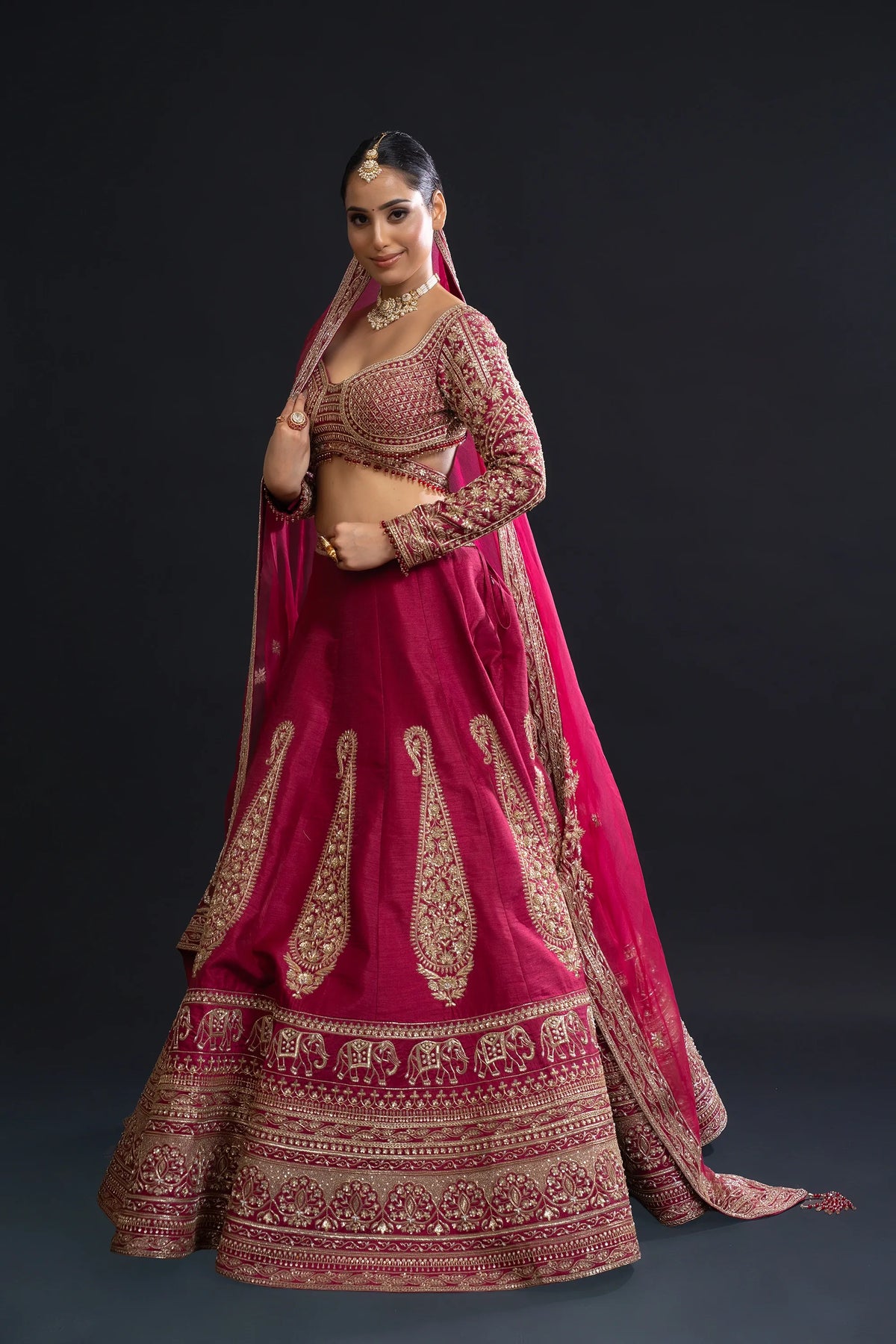
A contrasting waistband in a deeper or brighter shade than the lehenga body — even 2–3 centimetres of it — reads as a waist. Paired with a full circle flare and a corseted blouse, the rectangle silhouette becomes an hourglass on the wedding day.
Hourglass Body Type — Bridal Lehenga Guide
The hourglass figure — balanced bust and hips with a clearly defined waist — is architecturally the simplest to dress, and the easiest to over-dress. The proportions are already at rest; the design's only job is to celebrate them without obscuring them. The most common mistake an hourglass bride makes is choosing embellishment that competes with her silhouette rather than framing it.
Hourglass Body Type
Defined waist · Balanced bust and hips
Silhouette
All silhouettes work — this is the only body type for which this is true. The mermaid/fish cut maximises the waist-to-hip curve; the full circle flare adds theatrical drama.
Fabric
The entire fabric range is available. Velvet for maximum drama, raw silk for elegance, organza for a contemporary lightness. The figure supports them all.
Embroidery
Full coverage embroidery — heavy zardozi across all panels — is possible without the lehenga overwhelming the figure. The proportions absorb embellishment.
Blouse
Fitted and closely tailored to the waist — this is the one proportion worth emphasising above all others. A correctly tailored blouse on an hourglass figure is one of the most effective things in bridal dressing.
Neckline
All necklines work. The sweetheart is most classically romantic; the deep V is most dramatically modern; the high neck is most architecturally interesting.
Can-Can Volume
Moderate to full — the figure handles volume without difficulty. The mermaid silhouette uses no can-can and relies on the body's own curves for shape.
Jewellery
Anything — the proportions support statement jewellery without visual conflict. A heavy Polki set, a bold choker, chandelier earrings — all work.
Hairstyle
Both updo and loose waves work. Choose based on neckline: deep V and sweetheart are shown off by an updo; high neck is softened by loose hair.
Mistakes to Avoid
- Over-embellishing to the point where the silhouette is obscured — the figure is the asset; let it show
- An empire waistline that sits above the natural waist, hiding the most defining proportion
- Choosing a trend-led silhouette that abandons the waist entirely
The mermaid silhouette in a heavily embroidered velvet is the definitive expression of this body type's potential. It is also the most physically demanding lehenga to wear across a long wedding — ensure the fabric flexibility and hem length allow comfortable movement before committing.
Petite Body Type — Bridal Lehenga Guide

Petite brides — those under 5 feet 3 inches — have a single consistent challenge: anything that interrupts the vertical line of the body shortens the silhouette visually. This means that most decisions in designing a lehenga for a petite figure are actually decisions about elongation: how to draw the eye from the floor upward without interruption, creating the impression of greater height without the distortion of trying too hard.
Petite Body Type
Under 5'3" · Key goal: visual elongation
Silhouette
A-line or minimal flare — the gentler the flare, the taller the bride appears. Heavy circle flare adds horizontal mass that shortens the figure.
Fabric
Lightweight fabrics: silk, organza, tissue, lightweight georgette. Heavy fabrics overwhelm a petite frame and add visible weight.
Embroidery Pattern
Vertical embroidery patterns — butas (scattered motifs) arranged vertically, or vertical jaal — elongate visually. Horizontal border-heavy designs at mid-skirt cut the height.
Neckline
Deep V — creates a long vertical line from chin to waist that is the most powerful elongating device available.
Blouse
Short blouse (ending at or above the navel) with the lehenga waistband sitting high on the natural waist. This creates the optical illusion of longer legs.
Dupatta
Draped vertically — down the front of the body — to create an unbroken vertical line. Not draped horizontally across both shoulders.
Can-Can Volume
Minimal — just enough to give the skirt its shape. Excess volume is the single biggest mistake for petite brides.
Length
Exactly floor length — not trailing, which causes tripping, and not above the floor, which cuts the elongating effect.
Sleeves
Sleeveless or very short cap — long sleeves shorten the arm visually and interrupt the elongating line of the silhouette.
Jewellery
Delicate pieces in proportion to the frame — oversized statement jewellery overwhelms a petite silhouette and creates imbalance. A fine Polki choker and small chaandbaalis are ideal.
Hairstyle
Updo is essential — a high bun adds 2–3 inches of apparent height. Hair worn down creates a horizontal line at the shoulder that shortens the silhouette.
Footwear
Heels (3–4 inches) worn completely hidden under the floor-length hem. The height is added invisibly, which is the most elegant way to add it.
Mistakes to Avoid
- Heavy full circle flare that adds horizontal mass at the widest point
- Ankle or midi length (cuts the figure dramatically)
- Heavy, large-motif embroidery that overwhelms the frame
- Chunky, oversized jewellery
- Flat footwear (kitten heels or jutis with zero lift)
- Horizontal embroidery bands at waist or mid-skirt
A tonal outfit — lehenga, blouse, and dupatta in the same colour family with no strong contrast at the waist — creates an unbroken vertical line from collar to floor. It is the single most effective elongating technique available, and it reads as elegantly restrained rather than minimal.
Tall Body Type — Bridal Lehenga Guide
Tall brides — 5 feet 7 inches and above — have the most freedom of any body type and often use it least boldly. The most common regret among tall brides at Aahana's is not that they chose something too dramatic, but that they played it too safe: avoiding volume, avoiding heavy embroidery, avoiding the full circle flare they secretly wanted, because they were afraid of looking "too much." A tall frame carries more than any other. The mandate for tall brides is to use it.
Tall Body Type
5'7" and above · Key goal: embrace drama
Silhouette
All silhouettes — but the full circle flare is most spectacular on a tall frame. The greater the volume, the more the height is made an asset rather than a question.
Fabric
Heavier fabrics (velvet, brocade) that have weight work beautifully — the height provides the posture to carry them. A heavily embroidered velvet lehenga is uniquely suited to tall brides.
Embroidery
Full coverage embroidery — zardozi across all panels — is not only possible but encouraged. The tall frame provides the canvas for the artisans' most elaborate work.
Neckline
Horizontal necklines (square, boat neck, high neck) can work beautifully — they provide a counterpoint to the height that reads as deliberate framing rather than shortening.
Blouse
Longer blouse lengths are available to tall brides — an elongated blouse ending below the natural waist is flattering where it would overwhelm a petite frame.
Can-Can Volume
Maximum — full, layered can-can adds the horizontal drama that balances vertical height. Tall brides carry volume without looking overwhelmed by it.
Length
Floor length, and a short train (6–8 inches) in a contrasting lining fabric is a genuine option. It adds a formal drama few other body types can support comfortably.
Jewellery
Statement pieces — large chandelier earrings, heavy polki sets — are proportionate on a tall frame. Where they would overwhelm a petite bride, they balance a taller one.
Hairstyle
Loose waves or a low bun — updos are unnecessary for height and can over-lengthen the silhouette. Let the height work naturally.
Footwear
Kitten heels or flat jutis — height is already present and not in need of supplementing. Comfort across a long wedding is the primary consideration.
Mistakes to Avoid
- Playing it too safe — avoiding volume and drama out of unfounded self-consciousness about height
- Minimal embroidery on the assumption that "less is more" — less is sometimes less
- Very high updos that create additional unnecessary height
A full circle flare in heavily embroidered velvet, with a 6-inch silk-lined train in a contrasting colour, is perhaps the most dramatic bridal lehenga statement possible — and it is uniquely achievable for tall brides. If you have the height to carry it, this is the moment to do so.
Plus Size / Full Figure — Bridal Lehenga Guide

The most important principle for plus-size bridal styling is identical to the most important principle for every other body type: start with the silhouette, not the coverage. Garments designed to hide a body never succeed — they add fabric where clarity would serve better. The goal is a lehenga that fits precisely, moves freely, and makes the bride feel dressed rather than covered.
Plus Size / Full Figure
Fuller proportions · Key goal: flow, comfort, confidence
Silhouette
A-line with a structured bodice and well-calibrated can-can. The cape lehenga is an exceptional option — it creates clean lines over the midsection while adding elegance.
Fabric
Flowing outer layers (georgette, layered organza, chiffon) over a structured lining. The outer fabric moves and creates visual softness; the lining holds the shape. Avoid stiff brocade all over, which adds visual bulk.
Embroidery Placement
Panel embroidery rather than all-over density — concentrate embellishment at the hem border and dupatta border to draw the eye outward and downward, not to the midsection.
Neckline
Sweetheart or V-neck — lifts the bust, creates décolletage, and provides a flattering focal point above the midsection.
Blouse
A structured, corseted blouse with boning provides support and creates a defined waistline. Cap sleeves or three-quarter sleeves offer comfortable coverage without adding bulk.
Dupatta
Single shoulder drape or diagonal across the body — both create lengthening diagonal lines. A double dupatta works if the outer layer is very lightweight (tulle or organza).
Can-Can Volume
Moderate and well-calibrated. Enough for the skirt to fall cleanly away from the hips; not so much that it creates visible horizontal width at mid-thigh.
Jewellery
Bold is appropriate — statement choker, chandelier earrings, a maang tikka. A fuller figure carries bold jewellery without it looking oversized.
Hairstyle
Side bun or loose side-swept style — softer than a severe updo, and creates an asymmetry that draws the eye across rather than straight down.
Footwear
Block heel or wedge — provides the height of a stiletto with the comfort needed to wear across eight or more hours. Comfort is not a compromise; it is a requirement.
Sleeves
Cap or three-quarter — offers arm coverage for brides who prefer it without adding the shortening effect of a full long sleeve.
Makeup
Full-coverage foundation with highlighted cheekbones — creates facial structure that anchors the look above the embellishment of the lehenga.
Mistakes to Avoid
- Mermaid silhouette — clings through the thigh and creates visible physical discomfort
- All-over stiff brocade — adds visual weight at every point
- Very pale, embellishment-free fabric — without embroidery or texture, pale fabrics can appear to expand the silhouette
- Extremely full can-can — creates horizontal mass that widens rather than elongates
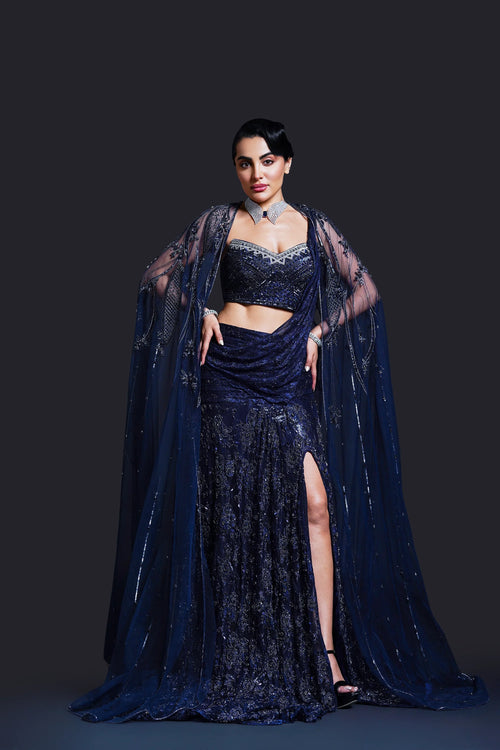
A cape lehenga — in which a cape draped from the shoulders replaces the traditional blouse — creates the most elegant and contemporary coverage for full-figure brides. The cape flows over the midsection and creates movement rather than structure, which is both more comfortable and more flattering than trying to contain the figure in a fitted blouse.
Athletic / Inverted Triangle — Bridal Lehenga Guide
The athletic or inverted triangle body type features shoulders broader than the hips, a well-defined but narrow waist, and minimal hip volume. The design goal is the inverse of the pear body type: visual weight must move downward. The silhouette needs to add volume and width below the waist to balance broad shoulders above.
Athletic / Inverted Triangle
Broader shoulders · Narrower hips · Key goal: add lower-body volume
Silhouette
Full circle flare or heavy A-line — maximum volume below the waist adds the hip width that balances the broader shoulder line above.
Fabric
Heavy fabrics for the skirt: velvet, brocade, heavily embroidered raw silk. The skirt needs physical weight to anchor the silhouette at the floor and create visual mass.
Embroidery Placement
Heavy embroidery on the skirt panels; deliberately lighter or absent on the blouse and shoulder area. The eye should move downward.
Neckline
V-neck or sweetheart — both narrow the apparent width of the shoulders by drawing the eye inward and downward.
Blouse
Sleeveless or simple cap sleeve — avoid shoulder embellishments, strong shoulder seams, or puffed sleeves that add width to an already wide area.
Dupatta
Pin to one shoulder only — no need to add width across both shoulders as in the pear type. A single shoulder drape maintains the diagonal line without widening.
Can-Can Volume
Maximum — full, layered can-can below the waist is the primary tool for balancing broad shoulders with an appropriately voluminous lower half.
Jewellery
Long pendant necklace to draw the eye downward and inward; avoid shoulder-grazing earrings that add horizontal width at the shoulder.
Hairstyle
Low bun or loose waves — updos add height and emphasis to the head and shoulders when the goal is to draw the eye downward.
Footwear
Any heel — the athletic figure carries heel heights comfortably. Choose based on comfort and event duration.
Mistakes to Avoid
- Wide boat neck or off-shoulder neckline — maximises the already widest point
- Heavy shoulder embellishments or structured puffed sleeves
- A-line with insufficient flare — doesn't add enough lower-body volume to balance the shoulders
- Shoulder-grazing chandelier earrings
A heavily embroidered hem border — the richest, most elaborate embroidery on the entire lehenga at the very bottom of the skirt — anchors the eye at floor level and creates a visual weight at the base of the silhouette that perfectly balances the broader shoulder line above.
Bridal Lehenga Colour Guide — Skin Tone and Season
Colour choice is where brides most often defer to trend over analysis. The problem with trending colours is that they are averaged across a range of skin tones and photographic conditions, neither of which match any specific bride's actual situation. The principle that governs colour selection at Aahana's is simpler: a colour is right when it makes the skin look luminous rather than flat, and wrong when it draws colour from the face rather than amplifying it.
By Skin Tone
| Skin Tone | Most Flattering | Use With Care | Avoid |
|---|---|---|---|
| Fair / Porcelain | Jewel tones (deep emerald, royal blue, plum, burgundy), classic bridal red, deep gold | Blush pink, powder blue (can look washed out without embroidery contrast) | Very pale ivory without warm-undertone embroidery |
| Wheatish / Golden | Warm shades — coral, orange-red, tomato red, mustard, gold, warm rust, peach | Cool pastels — lavender, mint (need warm embroidery to work) | Grey-toned shades that absorb warmth from the complexion |
| Dusky / Warm Brown | Bright, saturated shades — hot pink, bright red, burnt orange, electric blue, bright yellow | Deep jewel tones (can merge rather than contrast with a deeper complexion) | Very pale pastels (blush, baby pink) without significant embellishment |
| Deep / Rich Brown | Rich jewel tones (emerald, sapphire, amethyst), gold, electric pink, ivory with gold embroidery | Very dark shades (navy, very dark maroon) — need metallic embroidery to provide contrast | Dark shades without embellishment (reads flat in photographs) |
By Season and Venue
| Wedding Season | Recommended Palette | Embroidery Finish |
|---|---|---|
| Winter (Nov–Feb) | Jewel tones, deep red, burgundy, navy, plum — velvet shows at its best | Heavy zardozi, dabka in gold or antique gold |
| Spring (Mar–Apr) | Coral, peach, warm pink, mint, gold — transitional season, lighter saturation | Resham thread, sequin, pearl combinations |
| Summer (May–Aug) | Pastels with warm metallic embroidery, ivory, blush with heavy gold work | Lighter sequins, resham, pearl — avoid heavy zardozi in heat |
| Autumn (Sep–Oct) | Rust, burnt orange, terracotta, deep gold, warm maroon | Mixed — zardozi + resham + sequin works across autumn colour palette |
The dupatta does not need to match the lehenga. A contrasting dupatta — particularly in a complementary colour (red lehenga with a gold-bordered ivory dupatta; emerald lehenga with a deep pink dupatta) — adds visual interest and makes photographs more dynamic. A perfectly matching dupatta is safer but rarely more beautiful.
Bridal Lehenga Fabric Guide — Properties, Seasons, and Body Types
The fabric of a bridal lehenga is not merely a textural choice. It determines how the silhouette holds its shape, how the embroidery sits and catches light, how the garment moves in photographs, how much heat the bride will carry across a six-hour wedding day, and whether the lehenga can be preserved as an heirloom. Selecting fabric without reference to all of these criteria is how brides end up with lehengas that look spectacular in a showroom and disappoint on the day.
| Fabric | Properties | Best Season | Best Body Types | Embroidery |
|---|---|---|---|---|
| Raw Silk | Structured, matte-lustrous, holds shape; breathable relative to weight | Year-round | Rectangle, Hourglass, Athletic | Excellent — holds all types including heavy zardozi |
| Velvet | Maximum depth of colour; heavy; dramatic; cold-weather essential | Winter only | Tall, Hourglass, Rectangle | Best with zardozi; creates the deepest metallic contrast |
| Silk Organza | Sheer outer layer; lightweight; floats; very photogenic in natural light | Summer, Spring | Petite, Pear, Plus Size (outer layer) | Resham, sequin, cutdana — zardozi tears organza |
| Georgette | Fluid drape; moderate weight; slight texture | All seasons | Apple, Plus Size, Pear | Resham, sequin, mirror — avoid heavy metal embroidery |
| Tissue Silk | Extremely lightweight; iridescent; high shimmer | Summer | Petite (ideal), Pear | Light sequin and resham only |
| Brocade | Woven pattern; stiff; self-embellished; heavy; traditional | Winter | Tall, Rectangle | Works as fabric pattern; additional embroidery can over-embellish |
| Net / Tulle | Sheer outer; versatile; takes embroidery well | All seasons | All body types as outer layer over silk lining | Excellent base for sequin, resham, cutdana overlays |
| Chiffon | Very fluid; lightweight; softest drape; not structured | Summer, Spring | Apple (dupatta), Plus Size (outer panels) | Light only — sequin, resham |
Raw silk is the most heirloom-appropriate bridal fabric. Unlike velvet (which crushes and loses pile over time) or organza (which can shred at embroidery attachment points), raw silk ages gracefully. A raw silk lehenga stored correctly can be worn — or altered and worn — by the next generation.
Bridal Lehenga Embroidery Guide — Techniques, Weight, and Placement
Embroidery is the primary vehicle of luxury in bridal lehenga craft — and the primary source of cost, weight, and decision complexity. The most important thing to understand: more is not always more. The right embroidery is dense where density is needed and absent where absence serves. A lehenga with 40% embroidery coverage, correctly placed, outperforms one with 80% coverage, poorly placed.
| Technique | Description | Visual Effect | Best For |
|---|---|---|---|
| Zardozi | Metal wire (gold/silver) coiled and couched; heaviest traditional bridal embroidery | Three-dimensional, dramatic, catches light at multiple angles; regal and formal | Winter weddings, velvet base, hourglass and tall body types, evening ceremonies |
| Dabka | Thick coiled wire laid flat; lighter than zardozi | Strong geometric or floral definition; bolder than sequin | Geometric patterns; base motif work in combination embroidery |
| Resham | Silk thread embroidery; vibrant colour; lightest weight | Soft, colour-rich, traditional; timeless and craft-forward | All seasons; lightweight fabrics; petite and athletic brides |
| Sequin / Sitara | Flat reflective discs; lightest embellishment form | High sparkle, movement-activated shine; very photogenic; contemporary | Summer weddings; sangeet-adjacent colours |
| Cutdana | Small cut-metal beads; hand-set; between sequin and dabka in weight | Fine sparkle; more refined than flat sequin | Detail work with resham; fine border work |
| Pearl / Moti | Real or simulated pearls stitched individually | Soft lustre; extremely bridal; works across aesthetics | Ivory, blush, and pastel lehengas; petite brides (light weight) |
| Mirror Work | Circular mirrors set in embroidered frames; traditional Rajasthani craft | High visual impact; folk-luxury aesthetic; dramatic light reflection | Sangeet and pre-wedding; colour-blocked contemporary bridal |
| Mukaish / Badla | Flat metal strips woven into base fabric; all-over shimmer | Subtle shimmer without dominant pattern; moonlit effect | Minimalist brides who want shimmer without heavy embroidery |
"The best embroidery tells you where to look. It is a conversation between the designer and the eye of the observer — guiding it, holding it, releasing it."
— Nidhi Mehra, Aahana'sEmbroidery Placement by Body Type
| Body Type | Concentrate Embroidery | Minimise Embroidery |
|---|---|---|
| Pear | Blouse, shoulders, upper third of skirt | Hip panels, lower skirt |
| Apple | Lower skirt (hem border), dupatta | Blouse midsection, waist area |
| Rectangle | Waistband (contrasting colour), full skirt | No restriction — balance across panels |
| Hourglass | Any — full coverage works; waist area most effective | No restriction |
| Petite | Vertical buta pattern throughout; fine border at hem | Wide horizontal bands at mid-skirt |
| Tall | Anywhere — maximum coverage is uniquely possible | No restriction |
| Plus Size | Hem border, dupatta border, blouse | All-over dense midsection coverage |
| Athletic | Skirt panels (especially lower half and hem), dupatta | Blouse shoulder area, upper bodice |
Luxury Bridal Lehenga Shopping Timeline
Custom bridal lehengas pass through four distinct production phases, each with its own timeline. Compressing any of them produces detectable quality compromises — in embroidery density, in fit, or in the artisans' ability to apply their craft at the level that makes the difference between a beautiful lehenga and an extraordinary one.
Months
First Consultation
Design brief created. Measurements taken. Silhouette, fabric, colour, embroidery, and budget aligned. At Aahana's by Nidhi Mehra, all bridal sessions are by appointment.
- Bring your wedding date confirmation
- Bring groom's sherwani reference if coordination is required
- Bring wedding shoes or heel height confirmation
Months
Fabric Sourcing and Design Finalisation
Fabrics sourced from specialty mills in Varanasi (silk), Surat (organza), or artisan cooperatives. Dyeing to specific colour specifications takes 2–4 weeks. Design is finalised and embroidery pattern scaled to the bride's measurements.
Months
Hand Embroidery
The longest single phase. Dense zardozi on velvet requires 8–16 weeks of artisan time for a full bridal lehenga. Resham and sequin combinations take 4–8 weeks. This is where the garment becomes what it will be — this timeline cannot be compressed.
Weeks
First Fitting
Lehenga assembled and structural fit decisions made: blouse silhouette and boning, waistband placement, can-can volume, sleeve length. Take photographs in natural light — these inform the second fitting.
Weeks
Second Fitting and Alterations
Alterations from the first fitting are implemented. Dupatta is draped and pinned. Photograph in wedding shoes. Test the full movement range: sitting, walking, arms raised for pheras, dancing.
Week
Final Collection
Lehenga pressed, finished, packaged. Blouse hooks rechecked. Dupatta packed separately. Care instructions provided. Collect no later than one week before the wedding for any last-minute adjustments.
Brides who approach Aahana's with under 3 months' lead time are offered a curated selection from existing fabrics and semi-finished embroidery panels that can be completed within the available timeline. The design range is more limited, but the quality of construction and fitting is identical. Contact the atelier: hello@nidhimehra.in
Expert Styling Tips from Nidhi Mehra
These principles emerge most consistently across years of bridal consultations — observations that separate brides who feel completely at ease in their lehenga from those who spend the wedding day adjusting it.
- The blouse dictates the silhouette, not the skirt. A perfectly constructed blouse corrects proportion, creates waist definition, and anchors everything else. Invest proportionally in the blouse fitting — it pays the highest return of any single design decision.
- Test the lehenga in motion before the final fitting. Every fitting should include a walk across the room, a seated position held for two minutes, and arm-raised movement (simulating phera movements). A lehenga that works in all three positions works on the wedding day.
- The dupatta is a styling tool, not an accessory. How and where it is draped changes the entire silhouette. Spend time at your final fitting experimenting with drape positions before settling on one.
- Bring your full accessories to the second fitting. Heavy neckpieces change the perceived weight and proportion of the blouse. What reads as balanced without jewellery may look top-heavy once the full set is added.
- Colour reads differently in daylight and under wedding lighting. Ask to see fabric swatches under both natural light and tungsten/LED light before confirming colour. Blush and pale gold shift dramatically between settings.
- The inner lining construction matters as much as the outer fabric. A lehenga's silhouette is determined by its lining: the quality of can-can stitching, blouse boning, and underskirt fall. Ask specifically about lining construction — this is where quality differentiates.
- Comfort is a design criterion, not a compromise. Discomfort does not read as elegance in photographs — it reads as discomfort. Physical ease (breathing, sitting, moving, dancing) should be non-negotiable in the final fitting.
The Real Bride Consultation Process at Aahana's by Nidhi Mehra
Every bride who visits Aahana's begins with the same question: what are you trying to feel? Not what she wants to look like — that comes after. The feeling comes first, because the feeling determines the design language, and the design language determines every decision that follows.
The first consultation at Aahana's is not a sales appointment. It is a design conversation. Nidhi Mehra takes measurements — but more importantly, she observes how a bride stands, moves, and gestures. Which aspects of reference photographs she chooses to point to first. What she says when asked what she loved about those images. This observational layer — which cannot be captured in a brief sheet — is what separates a garment that fits from one that belongs.

To book your bridal consultation, visit the booking page or explore the current bridal collection. For the full range of silhouettes and embroidery options, the lehenga collection provides a starting point. If you are planning a sangeet or mehendi look alongside the bridal lehenga, the atelier offers complementary pieces for a cohesive bridal weekend wardrobe. For brides choosing a reception lehenga as a second outfit, a combined consultation is available to ensure both pieces are aligned.
24 Mistakes Brides Make When Choosing a Bridal Lehenga
Most bridal lehenga regrets fall into one of four categories: wrong timing, wrong silhouette, wrong process, or wrong priorities. This list addresses the most common — not as judgements, but as recoverable errors worth knowing about before the decisions are made.
Ordering too late
Under 3 months' lead time eliminates the best options. Quality cannot be hurried without cost.
Choosing without trying on
A lehenga that photographs beautifully on a sample body may not work on yours. No exceptions.
Wrong shoes at fittings
Hem length is calibrated to heel height. Wearing flats when you intend heels makes the hem wrong.
Ignoring body type for silhouette
Choosing a silhouette because it was beautiful on someone else. The frame changes everything.
No budget for the blouse
The blouse is 30–40% of the fit equation. A budget that covers only the skirt produces an incomplete lehenga.
Ignoring seasonal practicality
Velvet in a June outdoor wedding is a beauty decision that becomes a comfort problem by the third hour.
Not testing movement
Sitting, walking, and dancing are the three tests of a bridal lehenga. Test all three before finalising.
Choosing trend over timelessness
The most-remembered bridal lehengas in ten years are the ones that did not look dated after three.
Neglecting the dupatta
A dupatta that is an afterthought is visible as one. It should be designed, not selected.
Trusting screen colour for fabric
Website photographs render fabric colour inaccurately. Always request a physical swatch before confirming colour.
Excess can-can for petite frames
Heavy can-can is the single most common error for petite brides. It adds horizontal mass that shortens.
Exactly matching the groom
Identical colours read as coordination but lose individuality. Coordinate, do not match.
Buying accessories before the lehenga is final
Jewellery choices must respond to the final embroidery and colour. Buy it after, not before.
Incompatible neckline
The neckline is the first detail visible in most wedding photographs. It must work with both your neck length and your jewellery.
Over-embellishing
A lehenga with embroidery competing at every point overwhelms the bride within it. Let the garment serve, not perform.
Skipping the second fitting
The second fitting is where the first fitting's decisions are refined. Skipping it means the first fitting becomes the final — with all its uncertainties.
Wrong dupatta drape for body type
The dupatta should be draped for the body type, not styled generically. Confirm the drape at your final fitting.
Prioritising photographs over experience
You will remember how the lehenga felt to wear far longer than how it reads in photographs. Design for both.
Not communicating budget clearly
Without a clear number, designers offer options across a range that may include pieces far outside your comfortable spend.
Wrong blouse length
An elongated blouse on a petite bride shortens the torso. A cropped blouse on an apple-type exposes the midriff. Length is a body-type decision.
Too many embroidery thread colours
More than three thread colours creates chaos rather than richness. The most luxurious embroideries use two to three at most.
Ignoring total garment weight
A fully embroidered bridal lehenga can weigh 8–12 kilograms. Test the weight by wearing the sample for 30+ minutes before committing to higher density.
Not asking about care and storage
A bridal lehenga is an investment requiring specific care. Ask about dry cleaning, storage (acid-free tissue, not plastic), and embroidery restoration.
Wearing someone else's vision of beautiful
The most beautiful bridal lehenga is the one the specific bride feels completely herself in — not the one that received the most saves.
Frequently Asked Questions
Which bridal lehenga silhouette suits petite brides best?
Petite brides should choose an A-line or gently flared lehenga in lightweight fabrics like silk or organza. A deep V-neckline elongates the torso, a high waistband creates the illusion of longer legs, and an updo adds apparent height. Avoid heavy circle flare which adds bulk and shortens the silhouette.
What lehenga silhouette is most flattering for plus-size brides?
An A-line lehenga with a structured, corseted blouse and moderate can-can is ideal for plus-size brides. A sweetheart or V-neckline lifts the bust and creates décolletage. Flowing fabrics like georgette or layered organza for the outer panels create movement without adding bulk. Avoid stiff brocade and the mermaid silhouette.
How do I choose bridal lehenga colour for my skin tone?
Fair skin glows in jewel tones (deep emerald, royal blue, plum) and classic red. Wheatish skin is flattered by warm shades — coral, orange-red, gold, mustard. Dusky skin looks spectacular in bright saturated colours — hot pink, bright red, burnt orange. Deep skin tones shine in rich jewel tones and gold; avoid very pale pastels.
What is the difference between A-line and circle flare lehenga?
An A-line lehenga flares gently from the waist with panels cut at an angle — flattering for pear, apple, and petite body types. A circle flare uses panels cut in a full circle, creating maximum volume when the bride moves — ideal for hourglass, athletic, and tall body types who can carry the drama.
What fabric is best for a summer wedding bridal lehenga?
For summer weddings, lightweight fabrics are essential: pure silk organza, tissue silk, and chiffon keep the bride cool while looking luxurious. Layered organza over a silk lining gives the visual weight of a bridal lehenga without the heat of velvet or heavy brocade. Resham and pearl embroidery are preferred over heavy zardozi in warm weather.
How far in advance should I order a custom bridal lehenga?
Order your custom bridal lehenga at least 4 to 6 months before your wedding date. This allows time for fabric sourcing and dyeing (2–4 weeks), hand embroidery (6–16 weeks depending on density), construction and fitting (4–6 weeks), and any alterations. At Aahana's by Nidhi Mehra, orders placed with less than 3 months' lead time may have limited design options.
What jewellery should I wear with a heavily embroidered bridal lehenga?
With a heavily embroidered lehenga, let one element dominate. If the lehenga is heavily embroidered all over, choose jewellery in a single metal (gold or silver) without competing gemstones. A classic Polki or Kundan set with clean lines works best. Avoid layering multiple bold statement pieces — one statement necklace, one pair of earrings, and a maang tikka is sufficient.
Can pear-shaped brides wear a circle flare lehenga?
Yes, but with care. A circle flare adds volume below the hips, which can emphasise width in a pear shape. Balance this with a structured blouse with padded or puffed sleeves to widen the shoulder line. Place heavier embroidery on the blouse and upper skirt panels, not the hip panels. A double dupatta worn across both shoulders adds upper-body visual weight effectively.
What is the right amount of can-can for a bridal lehenga?
The right can-can volume depends on your body type and silhouette. Petite and apple body types need minimal can-can. Rectangle and athletic body types benefit from full can-can that creates curves. For all body types, the can-can should be calibrated so the bride can walk, sit, and dance comfortably.
How do I choose between velvet and silk for a bridal lehenga?
Choose velvet for winter weddings, evening receptions, or when you want maximum depth of colour and dramatic zardozi embroidery. Choose silk for year-round wear, summer and spring weddings, brides who want a lehenga that photographs beautifully in natural light, and those who want their garment to function as a heirloom. Raw silk is the most versatile and works across all seasons.
What hairstyle works best with a bridal lehenga?
Hairstyle should be chosen in relation to the neckline and body type. Petite brides should wear updos to gain apparent height. Pear-shaped brides benefit from updos that expose the neck and shoulders. For most bridal lehengas with heavy blouse embroidery and dupatta, pulling the hair back or up keeps the focus on the garment.
What is the average cost of a custom bridal lehenga in Noida?
Custom bridal lehengas in Noida range from approximately ₹80,000 for semi-custom with machine embroidery to ₹5,00,000 and above for fully custom, fully hand-embroidered couture pieces. At Aahana's by Nidhi Mehra, the investment reflects fabric quality, embroidery density and technique, and the number of fittings. A consultation helps establish the best design options within any specific budget.
Should I choose a bridal lehenga or bridal saree?
A lehenga offers better silhouette control, easier movement for dancing, and greater flexibility across body types. A saree is more traditional in some regions, more flexible post-wedding, and better suited to brides already comfortable draping sarees. For most North Indian and modern weddings, the lehenga allows more design expression and body-type optimisation.
Can I wear my mother's or grandmother's bridal lehenga?
Yes — with alterations from an experienced bridal atelier. Vintage lehengas typically need complete reconstruction (new can-can, waistband, blouse) to fit a different body. The original embroidery panels are preserved and remounted onto new fabric. Allow as much lead time as you would for a new piece — vintage garment work takes equivalent time.
What is the difference between couture and semi-custom bridal lehenga?
A couture (fully custom) bridal lehenga begins with original design — silhouette, fabric, colour, embroidery pattern, and construction are all created specifically for the individual bride. A semi-custom lehenga uses existing fabric and embroidery designs altered and fitted to the bride's measurements. Couture offers complete design originality; semi-custom offers faster delivery and lower investment but limited design differentiation.
Final Bridal Lehenga Buying Checklist
Use this checklist across your consultation and fitting process. Every box represents a decision that, left unmade, becomes a regret.
- Body type identified and primary design goal confirmed (elongation / balance / curves / drama)
- Wedding date confirmed and lead time calculated (minimum 4 months preferred)
- Season and venue type noted (indoor / outdoor / morning / evening)
- Budget confirmed and communicated to the atelier including blouse, dupatta, and accessories
- Silhouette selected with body type rationale understood
- Fabric selected based on season, silhouette, and body type
- Colour confirmed — swatch seen in both natural and artificial light
- Embroidery technique selected and placement reviewed for body type
- Blouse neckline, length, sleeve style, and construction (boning / lining) specified
- Can-can volume calibrated for body type
- Dupatta weight, border embroidery, and drape style confirmed
- First fitting scheduled with wedding shoes available
- First fitting tested in motion: walking, sitting (2 minutes), arms raised
- Second fitting scheduled with all jewellery available for proportion test
- Dupatta pinned in final drape position at second fitting
- Photographs taken in second fitting under natural light
- Garment weight confirmed — physically worn for 30+ minutes to test comfort
- Care and storage instructions received from the atelier
- Collection scheduled at least one week before the wedding
- Delivery packaging confirmed — acid-free tissue, not plastic garment bags
The Bridal Lehenga as a Once-in-a-Lifetime Object
There is a particular quality of attention that a bridal lehenga receives from the woman wearing it — and a particular quality of memory attached to it afterward. More than any other garment in a woman's life, the bridal lehenga occupies a singular place: worn for one day and remembered for decades. It exists in photographs that will be viewed by people not yet born. It carries, in its embroidery and its silhouette and its colour, something of the time and circumstance and feeling of the woman who wore it.
This is why the decision deserves the care this guide has attempted to provide. Not because a lehenga is more important than the marriage it accompanies — clearly it is not — but because the care invested in choosing it is a kind of self-respect. A bride saying: I took this seriously. I thought about what I wanted and why. I knew enough about myself and about the craft to make a decision I can stand behind.
The body type framework in this guide is a starting point, not a prescription. No silhouette is forbidden. No colour is automatically wrong. What this guide provides is the reasoning that allows a bride to arrive at her final choice with confidence rather than hope — knowing not just what she chose, but why it was right.
For brides who want to take this reasoning further — to see how a luxury bridal designer in Noida translates these principles into specific, original garments — Aahana's by Nidhi Mehra is available for private consultation by appointment. The conversation begins with the same question it always does: what are you trying to feel?
Begin Your Bridal Consultation
Every bridal lehenga at Aahana's begins with a private consultation — a design conversation, not a sales appointment.
Call or WhatsApp: +91 98990 04066
Email: hello@nidhimehra.in
By appointment only · Noida Atelier