Some things in a bride's life are decided with the head — the venue, the caterer, the florist. The lehenga is decided with something older and quieter than reason. It arrives, when it finally arrives, less as a choice than as a recognition. This is the one.
And the designer who makes that moment possible — who hears what has not yet been said out loud, and stitches it into silk — is the decision that shapes everything else.
In the National Capital Region, that role is being reshaped. A quieter, more considered form of luxury bridal couture is gaining ground, drawing brides away from the familiar chaos of the bazaar and toward something closer to what bridal shopping always deserved to be: unhurried, private, and entirely about her. Nidhi Mehra, widely regarded as the best bridal lehenga designer in Noida, has been at the center of this shift since the day she opened her atelier, Aahana's by Nidhi Mehra. Her design philosophy holds that tradition and contemporaneity are not opposites to be reconciled; in the right hands, they are collaborators. Her lehengas carry the weight of India's textile heritage without asking the bride to disappear inside it.
This guide is for the bride who already knows she wants something exceptional, but has not yet found the language to describe it. Whether she is from Delhi NCR, traveling in from Gurugram, or flying home from Toronto to begin her trousseau, what follows will illuminate not only why the right designer matters, but why the choice of Noida — and Aahana's by Nidhi Mehra in particular — is the one she will never second-guess.
Why Choosing the Right Bridal Lehenga Designer Matters

Wedding lehengas are produced, in their thousands, by factories that understand fashion. The best ones are made by designers who understand brides. The difference is felt on the body before it is visible to the eye — in a blouse that does not pull across the shoulders, a skirt whose weight falls properly, a dupatta that sits without pinning. Choosing the right bridal lehenga designer is the act of insisting on that difference.
1. The Anatomy of a Masterpiece
A bridal lehenga is, structurally, a feat of engineering. The weight of a fully embroidered skirt — zardozi-laden, lined in silk, supported by layers of can-can — can exceed fifteen kilograms. A couturier who truly knows her craft distributes that weight so that it is held, not carried. The bride stands tall. She moves. She dances well past midnight. When you work with the best bridal lehenga designer in Noida, impeccable tailoring is not a selling point. It is the prerequisite.
2. Translating Vision into Reality
Most brides do not arrive at a consultation with a finished vision — they arrive with a feeling. Perhaps it is the memory of their grandmother's phulkari dupatta. Perhaps it is a color they once saw at the hour before sunset. The right designer is fluent in that language. She converts half-formed instincts into concrete decisions about silhouette and shade, into a zardozi lehenga or a pearl-embellished pastel that harmonizes with the venue, the jewelry, the light of the particular hour of the ceremony. She makes the feeling specific.
3. The Power of Personalization
The problem with an altered sample garment is not the alteration itself — it is the compromise at the root of it. A custom designer lehenga is not altered; it is begun. The first stitch accounts for your shoulders, your waist, the particular way your posture holds a drape. By the time the garment is finished, it knows you. That intimacy of fit — the absence of any nagging, any pulling, any conscious awareness of the clothing during the rituals of an Indian wedding — is the quiet luxury that bespoke bridal couture exists to provide.
4. Heirloom Quality and Longevity
There is a particular kind of object that accumulates meaning rather than losing it. A couture bridal lehenga, made from archival-quality raw silk, embroidered with zari threads whose purity does not compromise, is one of those objects. It does not belong to one day. It belongs to a lineage. Decades from now, it will still hold its color and its weight, still carry the occasion in its fabric.
Why Noida is Becoming a Luxury Bridal Destination

For decades, Chandni Chowk and Shahpur Jat were the only pilgrimages a Delhi NCR bride was expected to make. The stores were magnificent in their excess — thousands of lehengas, every shade known to the subcontinent, vendors and voices competing from every direction. It was overwhelming by design. The assumption was that abundance required theater, and theater required noise. The modern bride, increasingly, disagrees.
The Shift from Chaos to Exclusivity
Noida's luxury bridal ateliers have risen precisely because brides have begun to ask a more honest question: should buying the most important garment of my life feel like navigating a souk? The answer, for a growing number of discerning clients from Greater Noida, Gurugram, and South Delhi, is no. Noida offers these brides an alternative — wide, unhurried streets, beautiful studio spaces, and an ethos of private, focused service that treats the consultation as the art it actually is.
The Rise of the Private Atelier
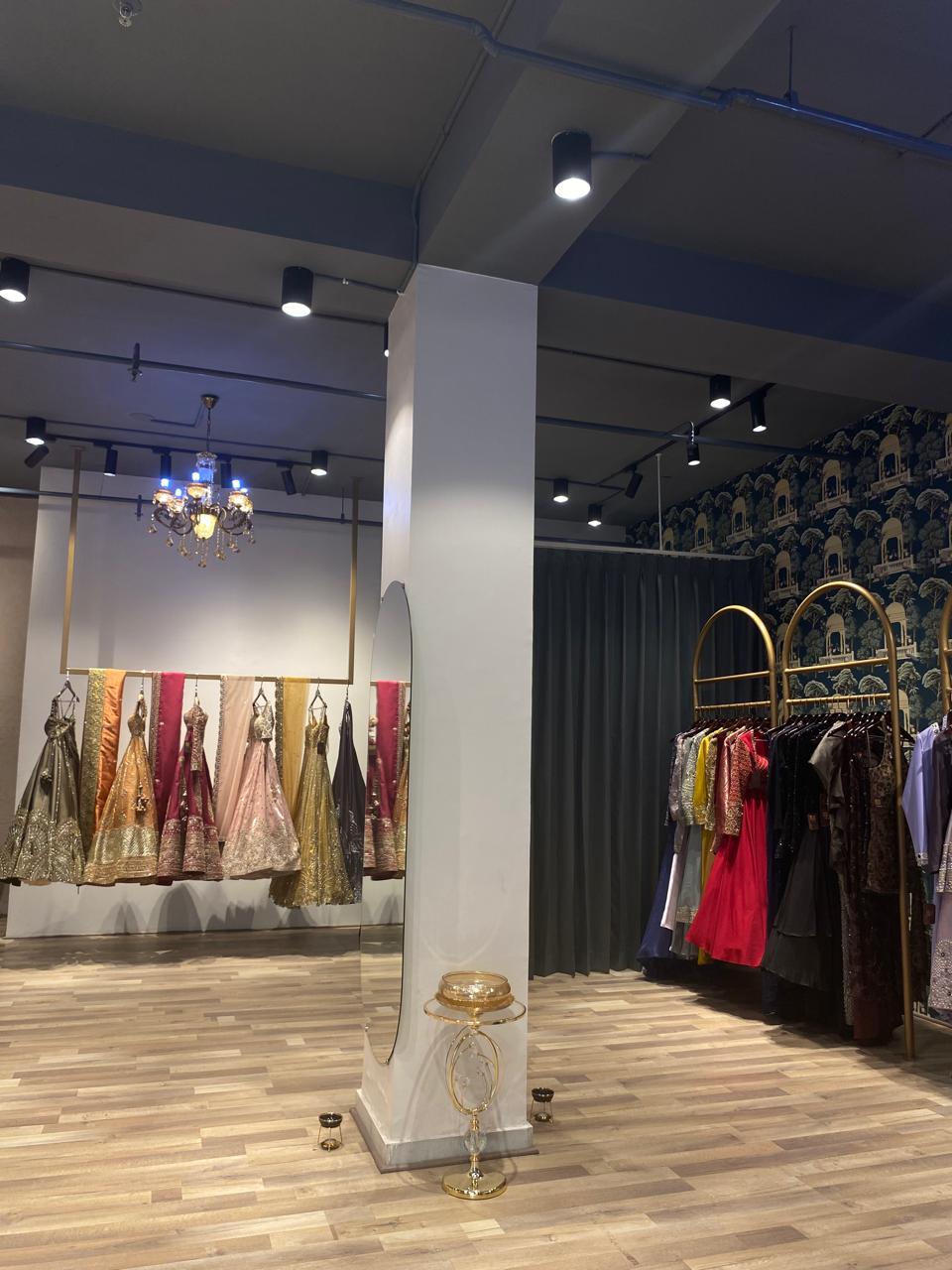
The private atelier is not an innovation — Paris invented it a century ago, and India's finest couturiers have always known its value. What is new is its arrival in the NCR's bridal landscape in any number worth speaking of. In Noida, designers like Nidhi Mehra have built studios where the architecture itself signals intention. No racks, no queue, no other bride in the next room. An appointment here is an allocation of undivided creative attention — something that cannot be offered in a showroom.
Accessibility for NRI Brides
An NRI bride returning to India for her trousseau has, at most, two or three weeks. She cannot afford to spend them navigating congested city centers in peak season heat. Noida, connected by expressway to the airport and to central Delhi's luxury hotels, lets her move efficiently between appointments without giving up the unhurried quality of each one. For the international client accustomed to a certain standard of service, the private atelier model in Noida is not a pleasant surprise. It is simply what she expected.
Why Nidhi Mehra Stands Out: The Visionary Behind Aahana's

Reputation in couture is not built with press. It is built one bride at a time — through the fit of a blouse, the precision of a border, the way a bride feels when she finally stands in front of a mirror and knows she is done looking. Nidhi Mehra has built hers exactly that way. Her atelier, Aahana's by Nidhi Mehra, located at A-77, Block A, Sector 4, Noida, is where that reputation lives: in the quality of the fabric on the bolt, in the steadiness of the artisans' hands, and in the particular attention Nidhi herself brings to every single consultation.
1. The 'By-Appointment-Only' Philosophy
Aahana's is not a store. It is not a showroom. It is a studio that admits only brides it can serve completely. The by-appointment-only model is not a gesture of exclusivity for its own sake — it is the only model under which bespoke luxury bridal couture can be honestly offered. When you arrive at the Sector 4 atelier, the studio's entire focus contracts around you. No walk-in traffic, no concurrent appointments, no junior stylist filling in while the designer handles someone more important. There is no someone more important. There is only your trousseau.
2. The Direct Designer-to-Bride Connection
At most commercial fashion houses, a bride's first three consultations may be completed entirely without meeting the person whose name is on the label. At Aahana's, the consultation begins with Nidhi Mehra and remains with her. She asks about your wedding the way a perceptive guest would — about the light at the venue in the late afternoon, about the jewelry that has been in the family for years, about how you actually move when no one is watching. That information becomes design. No intermediary translates it.
3. A Signature Aesthetic of "Modern Royalty"
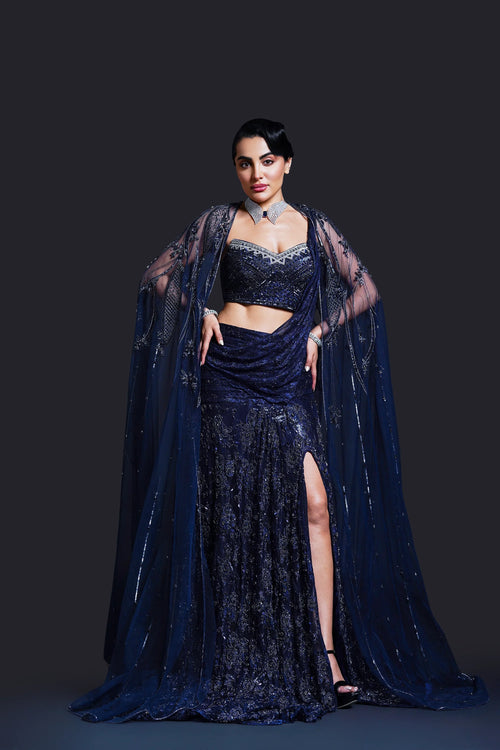
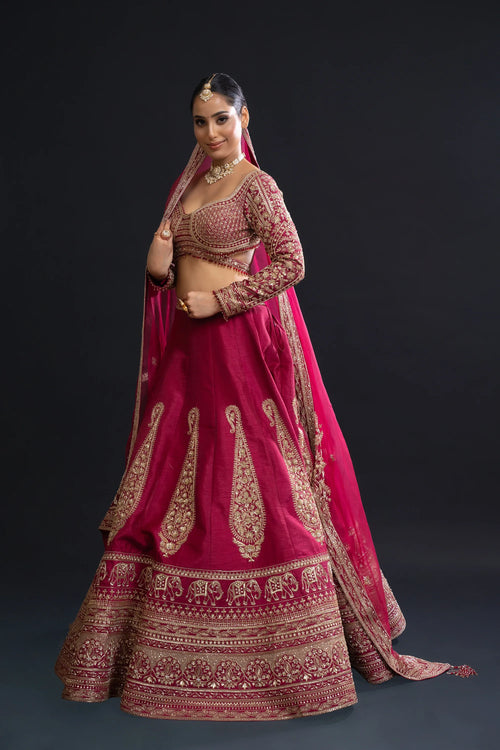
If a phrase must be found for what Nidhi Mehra makes, it is Modern Royalty: the vocabulary of traditional Indian grandeur — the deep sindoori reds, the formal maroons, the weight of real zari — used with a restraint that belongs entirely to the present. She does not embellish until a garment collapses under its own decoration. She stops at the point where ornamentation begins to serve the woman wearing it, and not before. Her pastels — dusty rose, mint, champagne ivory — are not concessions to a trend but full expressions of the same philosophy: that a bride should be the most visible thing in the room, and that the lehenga is what makes that possible.
4. Empowering the Bride
Nidhi Mehra has a principle she returns to often, and it shapes every structural decision she makes: the bride should wear the lehenga, not be worn by it. This is not rhetoric. It is engineering. The can-can is calibrated to provide volume without mass. The lining breathes. The blouse is fitted with enough precision that it does not demand attention during a seven-hour wedding. The bride can sit, embrace, dance, and finally let someone lift her off her feet — and the garment holds, because it was built to follow her, not to contain her.
Bridal Craftsmanship and Hand Embroidery: The Soul of the Lehenga

The thing that separates a couture bridal lehenga from everything else the fashion industry produces is not the price. It is the hours — and what happens inside them. A single Nidhi Mehra bridal creation may carry between 500 and 2,000 hours of unbroken handwork. Those hours belong to artisans who learned their techniques from parents who learned from grandparents, passing forward a form of knowledge that cannot be digitized or accelerated without being destroyed. At Aahana's by Nidhi Mehra, engaging those artisans is not a design choice. It is a conviction.
The Art of Zardozi
Zardozi is the oldest and most demanding embroidery tradition in India's bridal vocabulary. Authentic gold and silver metallic threads — zari — are manipulated by hand alongside dabka wire coils and metallic sequins to build motifs with genuine dimension. A peacock executed in zardozi does not lie flat against the fabric; its feathers seem to move as the bride moves, catching light at angles that shift with every step. Mughal jaal work — the interlocking lattice patterns drawn from the carved stone screens of Fatehpur Sikri — is among the most painstaking expressions of the form. At Aahana's, it is executed with the same reverence it has always demanded.
The Elegance of Resham and Aari
Resham embroidery — pure silk thread, drawn through fabric in combinations of flat stitch and aari chainwork — achieves something that metallic embroidery cannot: warmth. Color moves differently in resham than in zari. A rose can graduate from its darkest center outward through five distinct pinks, each tone resolved by a needle moving at a pace that allows for judgment at every stitch. The result reads more like a painting than a textile. For brides who find zardozi too formal, resham and aari offer an alternative equally rooted in craft.
The Sparkle of Mukaish and Badla
Mukaish and badla work produce the most ethereal surface embellishment in the Indian repertoire: fine metallic wires threaded directly through the fabric, forming scattered stars, delicate vines, and geometric clusters that catch and redistribute light. Under the warm illumination of a mandap or a reception stage, a lehenga embellished with mukaish does not simply shine. It seems to breathe. The effect is quieter than sequins and far more unusual — something brides at Aahana's often notice on other women before they think to ask for it themselves.
Pearl, Crystal, and Cut-Dana Embellishments
Nidhi Mehra's contemporary collections integrate freshwater pearls, Swarovski crystals, and cut-dana — faceted glass beads that split light with the efficiency of a prism — into embroideries that feel both classical and specific to the present. These elements are hand-sewn, each one placed deliberately. A dupatta border traced in pearl and crystal reads differently in morning light than it does by candlelight. That responsiveness to environment — a garment that is not the same thing twice — is one of the quieter signatures of work done this carefully.
The Bridal Consultation Experience: What to Expect
A consultation at Aahana's by Nidhi Mehra does not begin with a tour of the showroom, because there is no showroom. It begins with a question. Every bride is different, and the process here is built around that fact. What follows is the form that process typically takes — though it is flexible enough to accommodate whatever the bride needs it to be.
Booking Your Appointment
Since Aahana's operates exclusively by appointment, it is highly recommended to reach out via WhatsApp at +91 98990 04066 or email hello@nidhimehra.in well in advance — ideally 4 to 6 months before your wedding date.
Step 1: The Discovery Session
You arrive at the Sector 4, Noida atelier and are shown into a private suite. There is no waiting room, because the appointment was made for now, and now is when you begin. Nidhi wants to hear about your wedding before she shows you anything. Where is the ceremony taking place? What time of day? What does the venue look like when the light is at its best? How do you want to feel when you walk in? These are not intake questions. They are the brief from which everything else follows.
Step 2: Silhouette and Concept Curation
The first sketches arrive after the conversation, not before it. Nidhi presents concepts drawn directly from what she heard — silhouettes considered against your proportions, your jewelry, the movement of the ceremony. Does the skirt read as a dramatic umbrella flare, commanding space? Or an A-line, cleaner and more controlled? Is the blouse's neckline a statement, or does it defer to the necklace? The dupatta's drape is decided here, not improvised at the fitting. Every line is argued for before it is cut.
Step 3: The Textile and Embellishment Review
The tactile phase of the consultation cannot be replicated on a screen — which is why it matters that the atelier is a physical space. Fabrics are brought out and held in different light: the same deep maroon velvet under the warm overhead lamp and then by the window, the same organza against fair skin and against deeper skin. You feel the weight difference between a zardozi panel and one worked in resham. The color palette is not decided by what looks beautiful in the abstract but by what is true to you in this specific light, with this specific jewelry, on this skin.
Step 4: The Measurement and Toile Fitting
Measurements are taken with the kind of precision that makes fitting a later formality rather than a reckoning. For complex constructions — heavily embroidered pieces, unusual silhouettes, garments with a very specific structural intent — a toile may be made first: a full-scale mock-up in inexpensive fabric that tests every decision before the real silk is cut. This is the most unglamorous part of couture. It is also the reason the final fitting almost never surprises anyone.
The Fabric Selection Guide: The Foundation of Couture
Design begins in the mind, but couture begins in the textile. As the best bridal lehenga designer in Noida, Nidhi Mehra sources fabric the way a writer selects words — each choice made for what it can do that nothing else can. Understanding what each textile offers is the first step toward knowing what your lehenga should be made of.
1. Regal Velvets (Micro-Velvet)
For a winter wedding or a late-evening reception, the argument for velvet is immediate. Premium micro-velvet has a pile soft enough to drape without adding bulk, and a depth of color that makes gold zardozi appear lit from within. No other fabric produces that particular contrast — the dark richness of the ground and the three-dimensional brilliance of the embroidery — with the same authority.
2. Pure Raw Silk
Raw silk's faint texture — its subtle irregularity, the way it holds the light without being glossy — gives it a warmth that processed fabrics cannot replicate. It holds its shape through hours of wearing, accepts embroidery of every kind without losing its structure, and photographs beautifully in natural light. For a bride who wants presence without drama, raw silk remains the most honest choice.
3. Banarasi Brocade
A Banarasi silk brocade enters a room carrying its own credentials. Woven in Varanasi on handlooms by craftspeople who have spent their lives at the shuttle, with real gold or silver zari worked directly into the weave, these textiles need nothing added to justify the word opulent. At Aahana's, Banarasi brocade is used for lehengas where the fabric is the statement — a vintage sensibility supported by minimal additional embroidery, allowing the weave to speak at its own volume.
4. Ethereal Organza and Tulle
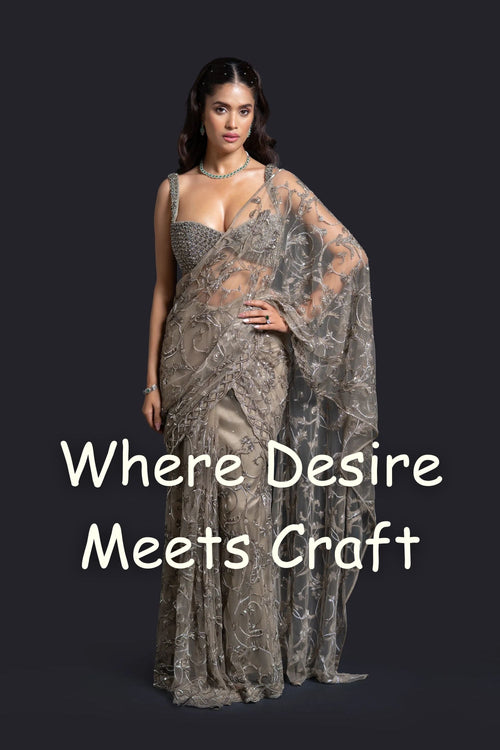
There are brides who want to appear to move through light rather than against it. For them, pure silk organza and fine French tulle — layered over solid silk grounds and embellished with the softest possible resham or pearl — produce a quality that heavier fabrics cannot: the impression of floating. For summer ceremonies or any bride drawn to pastel palettes and a more contemporary silhouette, these fabrics do not compromise on beauty. They redefine it.
5. Flowing Georgette and Chiffon
The Sangeet is not the wedding — and the Mehndi is not the Sangeet. Each pre-wedding function has its own register, its own relationship to movement and freedom. Georgette and chiffon understand this. They follow the body's rhythm with a responsiveness that structured fabrics resist, which is why the bride in a Nidhi Mehra georgette ensemble at her Sangeet often looks — and feels — more genuinely herself than she has in months of planning.
The Custom Bridal Lehenga Process: From Sketch to Reality
A bespoke Nidhi Mehra lehenga is made slowly, because speed and couture are incompatible. The process that follows the consultation is one of the most deliberate sequences in fashion — slow fashion at its most serious, each stage dependent on the one before it.
1. The Loom and the Dye
Color is the first craft. The chosen fabric is dispatched to master dyers who work not from a standard swatch book but from the bride's specific intention. Pomegranate red is not a generic crimson; it has warmth in its orange undertone, a particular richness when it catches candlelight. Dusty lavender has to carry just enough grey to read as sophisticated on camera. This precision — the difference between a color that is close and a color that is right — is what the dyeing process exists to achieve.
2. The Adda (Embroidery Frame)
The dyed fabric is stretched across an adda — a large wooden embroidery frame that holds it perfectly flat, without distortion, for the months of handwork ahead. The design is transferred from a full-scale paper stencil, a khakha, using chalk paste dusted through the pattern. At this point, the lehenga exists as an outline: the ghost of the finished work, waiting for the needles.
3. The Art of the Needle
Weeks pass. Sometimes months. A team of artisans sits around the adda, each responsible for specific elements of the composition. The major motifs, the secondary borders, the infinitely patient density-work that fills the ground between them. Nidhi moves through the studio during this period, checking alignment, measuring the consistency of the embroidery against her standards. A motif that has shifted by a centimeter is moved back. The density in one panel that does not match the others is reworked. The standard is not approximate here. It is non-negotiable.
4. Construction and Finishing
The embroidered panels leave the adda and arrive in the tailoring department, where the lehenga takes its final three-dimensional form. The lining is chosen and applied. The can-can is calibrated for the right volume — enough to hold the silhouette, not so much that it fights the body. The edges are finished: latkans, tassels, hand-worked piping, customized borders whose details are decided during the consultation and executed here with the same care as everything else.
5. The Final Bridal Fitting
The final fitting is not an audit. It is a conversation between the completed garment and the woman who will wear it. Small refinements are made — a breath taken in at the waist, the hem marked exactly over her bridal heels, the dupatta draped three ways before the right way settles. When she turns to the mirror, she is not evaluating fabric and stitching. She is meeting her bridal self, perhaps for the first time. That moment, in the Noida atelier, is what the last several months of making have been building toward.
Bridal Styling Advice from Nidhi Mehra
A lehenga is the center of the bridal look, not the whole of it. Nidhi Mehra's expertise extends beyond the garment to the complete image — the jewelry, the footwear, the relationship between embellishment and makeup. Her guidance here is practical, not prescriptive: the goal is always coherence.
The Rule of Balance
True luxury is about harmony. If your lehenga is heavily embellished, your jewelry and makeup should complement, not compete with, the outfit.
1. Jewelry Pairing
The neckline of a custom blouse is a decision about jewelry as much as about fabric. Read the architecture of the neckline first, and the jewelry follows from it naturally:
- Deep V-Necks: The long vertical line calls for jewelry that echoes it — layered Polki or Kundan necklaces that move with the opening rather than across it.
- High Necks/Chokers: When the blouse already meets the jaw and carries its own embroidery, the answer is not a necklace but an absence of one — replaced by statement chaandbaali earrings and a maang tikka that read as deliberate rather than minimal.
- Sweetheart Necks: The collarbone is exposed and the framing is natural. A single Polki or Kundan choker sits exactly where the eye wants to go.
2. The Double Dupatta Trend
The double dupatta is one of the most considered solutions in Nidhi Mehra's design vocabulary: a heavier, more formal dupatta — silk brocade or velvet — draped over the shoulder, and a lighter, sheerer one in tulle or organza drawn over the head during the ceremony. Each does its job without asking the other to do it. The bride is dressed for the full weight of the occasion while her head remains light and her expression unobstructed.
3. Footwear Matters
Bring your actual wedding shoes to every fitting from the second appointment onward — or shoes of the exact same heel height. A bridal lehenga's hem is not estimated. It is measured: long enough to graze the floor and hide the footwear completely at rest, short enough to walk without lifting the front. That calculation changes with every centimeter of heel, which is why the fitting and the footwear are inseparable. And if the wedding will last eight hours across changing terrain — and most Indian weddings do — a block heel or a wedge is not a concession. It is wisdom.
4. Makeup and Hair Synergy
Share photographs of your lehenga — its color, its weight of embellishment, its silhouette — with your makeup artist months in advance. For a deep red zardozi lehenga, the classic bridal vocabulary works because it is the right vocabulary: defined eyes, a bold lip, hair dressed formally and adorned with florals. For a pale organza with pearl embellishment, the instinct should run in the opposite direction — luminous, glowing skin, hair that moves and is not too ordered, a lip that suggests color rather than announces it. The garment and the face are a single composition. They should be planned as one.
Real Women Insights: The Aahana's Experience

The most reliable account of what a designer actually delivers is not found in editorial features. It is found in what brides say to their cousins and their friends — in the particular specificity with which they describe something that genuinely changed for them. Over the years, Aahana's by Nidhi Mehra has dressed brides from across Delhi NCR and from every major city in the world. What they describe, with remarkable consistency, is this:
- "A Stress-Free Sanctuary" The contrast between the Noida atelier and the Delhi markets is the first thing many brides mention — not just the quiet, but the way the quiet changed how they thought about their own choices. Without the noise of other buyers and competing merchandise, they found they knew what they wanted much more quickly than they expected.
- "Impeccable Fit and Comfort" Brides who anticipated being restricted by their lehenga — anticipating the constriction that heavy bridal wear so often demands — speak of dancing late, sitting cross-legged during rituals, embracing guests without thinking twice. The construction that makes this possible is invisible when it works, which is precisely the point.
- "A Designer Who Actually Listens" This is cited more often than any technical quality. Nidhi Mehra is described, again and again, as a designer who treats a bride's hesitations and half-formed ideas as seriously as she treats the finished reference image — who takes a bride's insecurity about her arms and solves it with a sleeve design rather than dismissing it, who takes a bride's unconventional color idea and finds the version of it that actually works.
- "Flawless NRI Coordination" For NRI brides based in the US, UK, or Canada who cannot make multiple trips to India, Aahana's virtual consultation process — fabric samples by courier, measurement guidance by video, design decisions documented and shared at every stage — consistently produces garments that arrive or are collected with no alteration needed. The precision is not accidental. It is the result of a process designed from the beginning with the remote bride in mind.
The bride should wear the lehenga, not be worn by it.
— Nidhi Mehra
Frequently Asked Questions
To help you prepare for your couture journey, we have compiled the most common questions asked by brides seeking the best bridal lehenga designer in Noida.
Where is Nidhi Mehra's bridal atelier located?
Aahana's by Nidhi Mehra is located at A-77, Block A, Sector 4, Noida, UP 201301. The studio is easily accessible from across Delhi NCR, Greater Noida, and Gurugram.
Can I walk in to browse the collection?
No. To maintain exclusivity and provide a highly personalized experience, Aahana's operates strictly by appointment only. You must schedule a consultation prior to visiting.
How do I book a bridal appointment?
Reach out directly by calling or sending a WhatsApp message to +91 98990 04066, or by emailing hello@nidhimehra.in. Full information is also available at nidhimehra.in.
How far in advance should I order my bridal lehenga?
Every garment at Aahana's is handcrafted from the first stitch. Placing your order 4 to 6 months before your wedding date is strongly recommended — this window allows adequate time for custom dyeing, hand embroidery, tailoring, and multiple fittings without any element of the process being rushed.
Does Nidhi Mehra design outfits for the groom or the bride's family?
While the primary focus of Aahana's is luxury bridal couture, Nidhi Mehra regularly curates complementary outfits for the bride's mother, sisters, and close family members — ensuring the aesthetic of the wedding party holds together as a considered whole.
Are virtual consultations available for NRI brides?
Yes. NRI brides are a consistent and warmly received part of the Aahana's clientele. Virtual consultations are conducted via video call, with fabric samples dispatched by courier and precise measurement guidance provided at each stage to ensure a flawless custom fit regardless of geography.
What is the starting price for a custom bridal lehenga?
Pricing at Aahana's is entirely bespoke, determined by the fabric, the density and type of hand embroidery, and the complexity of the design. During your consultation, Nidhi Mehra will work with you to realize your vision within your budget — honestly, and without compromise to quality.
A wedding lehenga carries more than the bride who wears it. It carries the weight of a family's history, the quiet ambitions of years of imagining, the particular quality of light on a single afternoon that will not come again. The garment deserves to be made with the seriousness that occasion demands.
Choosing Nidhi Mehra — the best bridal lehenga designer in Noida — is not the resolution of a search. It is the beginning of something better. At Aahana's by Nidhi Mehra, the experience of commissioning a bridal lehenga is rebuilt from first principles: private, deeply personal, and anchored in craft that has no shortcut. From the initial consultation to the final fitting, every stage of the process is in service of one outcome — a bride who walks into her ceremony knowing that the garment she is wearing was made entirely for her, and feels, in every fiber and seam, exactly like it.
Begin Your Couture Journey
Book Your Exclusive Bridal Consultation
The most important garment of your life should be made by someone who understands why it matters. That conversation begins with a single appointment.
By Appointment Only
Disclaimer: This editorial is a curated guide to luxury bridal couture and represents the design philosophy and exclusive services of Aahana's by Nidhi Mehra.